Pokazywanie postów oznaczonych etykietą CNN/BBC/F24. Pokaż wszystkie posty

wtorek, 4 sierpnia 2009

Matt Lucas on fame, body image and relationships

From
June 6, 2009

Bald at 6, a father in prison... Matt Lucas’s childhood could read as a misery memoir. Yet it wasn’t quite like that. Here he talks frankly about family, fame, body image and relationships, and how, with comedy as his weapon, he’s emerged a thoroughly grounded man who couldn’t be more unlike the gallery of grotesques he’s so famous for creating

Portrait of Matt Lucas shedding a tear

The comedian Bob Mortimer once described Matt Lucas as “the angriest man I have ever met”. Lucas was 18 when Mortimer said it and he’s 35 now; the quote has been hanging around his neck for a long time, so maybe it’s time to take it off. “Teenagers can take themselves very seriously; you spend too much time on your own, you start to mythologise yourself. You wear your perceived nonconformity on your sleeve.”

Lucas didn’t seem angry when I met him. Not at all. He gets upset and depressed from time to time, he says, like many people. But in our interview he was amusing, polite, most of all thoughtful. He seemed like a man who has put in a lot of work on himself, and the work has paid off. The tears of a clown may well have flowed 15 or 10 years ago; I’m not sure they do any longer.

We meet in a photography studio in North London. He is here to publicise his new BBC series, Kröd Mändoon and the Flaming Sword of Fire, a “Blackadder meets Red Dwarf kind of thing” in which he plays an “Alan Rickman-esque Sheriff of Nottingham psychotic baddie. I got the script and it really made me laugh. I auditioned for it and got the role. It was a giggle.”

He’s been followed to the studio by paparazzi, “but it would be churlish to aspire to be on television for many years and then to be on television and moan”. The media have, in any case, “cottoned on to the fact that a picture of me as Vicky Pollard is a lot more interesting than a picture of me walking my dog [Milo, two, chocolate Labrador]. Also, for the majority of the time that I’ve been famous, I’ve been in a relationship, and to be in a monogamous gay relationship is not as interesting as being, say, straight and single.”

Like his Little Britain partner, David Walliams, for instance? “Like David or Russell Brand or all those people. And they would be considered sexier and more attractive than me. I don’t crave more attention than I get. I will always, like the vast majority of people, look at a photo of myself and wince or cringe. I’ll always have that, but I think it’s quite natural.”

When we met some months ago, Lucas was single again after his long relationship with Kevin McGee ended in summer 2008. “I was with Kevin for almost six years, from August 2002.” The two men had had a civil partnership in 2006, finally dissolved in January this year. Lucas and McGee have both a gentlemen’s and a legal agreement not to discuss their relationship. “We turned down offers to photograph our ceremony. Kevin didn’t ask to be in the public eye, I still feel very protective towards him,” says Lucas. “I’m not in another relationship,” he said at our interview, “and it’s not something that I am looking for.”

Months later, however, during a telephone update, that situation has changed. “There is someone I like at the moment,” he says, “who likes me. It’s very early days and it came as a surprise to me. That’s all I’m going to say; I don’t want to jinx anything.”

The other big change between the initial interview and the phone follow-up is that Lucas has been on a serious, and so far successful, diet. “I was 106 kilos [getting on for 17 stone] when we met. I’m 90 kilos now.” This equates, he says, to ten inches around his stomach. He wants to get to 70-75 kilos (about 11 and a half stone) which, for a man of 5ft 6½in (“I really treasure that half”), “may still be a bit tubby, but I don’t mind”.

Is he feeling more attractive? “A little, maybe. But then, almost everybody I’ve ever dated, I’ve felt they were really handsome and they’ve felt the opposite. Beauty is in the eye of the beholder.”

For the photo shoot, Lucas is wearing a green corduroy suit and a bright red shirt. You’d think maybe he was a classic look-at-me extrovert, but he isn’t at all. Instead, this chap who dressed up in a Babygro when he was first on TV at the tender age of 18 in Shooting Stars, or strutted around in spandex as Daffyd the only gay in the village, is self-effacing to the point of shyness.

We sit in the café at the photography studio. He has a hot chocolate and a cookie (this is pre-diet). He speaks quietly, doesn’t draw attention to himself. His humour is the opposite of slapstick: so deadpan it takes a moment for the gag to register. When I ask him if he weighs himself, for instance, he says, “Yeah, I do, and then I get peckish and eat the scales.”

I say I’m someone whose weight also fluctuates dramatically. “Whereas I’m lucky I can eat and eat and eat and not put on an ounce.”

The early years

Lucas hasn’t given that many interviews, and those he has done tend to major on the stereotype of the sad funnyman. Admittedly, the stereotype has some mileage. But if there is one theme to our interview it is Lucas’s insistence that this unhappiness is not and never was the whole story.

“There were loads of happy memories from my childhood. There’s a temptation to characterise comedians as having a monopoly on suffering, and you can look at the facts and say, ‘Well, his hair fell out when he was 6, his parents divorced, his dad went to prison, questions over sexuality, struggles with weight,’ and assume every waking hour was a tyranny, but I don’t regard it as such at all. I had many happy moments watching Arsenal play, going to the theatre, wonderful friends, many of whom I still see, and a happy family. Many people have difficult lives and I don’t regard myself as one of them.”

The hair loss may have been the result of his being knocked down by a car when he was 4 and on holiday in Portugal. “Some medics thought it might be delayed shock.” Growing up, he says, he was “the bald kid. The Bald Man of Stanmore. I couldn’t get away with anything. I did feel very self-conscious about my appearance. Going through puberty was hard.”

The sudden and total hair loss is more likely to have been hereditary, as his father had also lost his hair, when he was about 13. “My dad wore a wig when we were growing up, a brown, Frankie Howerd style.” One of the traumatic things about visiting his father in prison in Aylesbury was he was not allowed to wear his wig. “I had never seen him before without it.” Going to visit his dad in prison was, he says, “really, really horrible. But I loved seeing him.”

Lucas’s parents separated when he was 10. He stayed with his mother and saw his dad every weekend. Then, when he was 12, his father, an aluminium importer, “made some bad decisions” to try to protect his failing business. “‘Cooking the books,’ I suppose they would call it. His intentions were good but his actions were a mistake.”

Lucas’s father was convicted of fraud and served six months of a nine-month sentence. He later remarried, as did Lucas’s mother. A decade later, when Lucas was in his early twenties and well-known for Shooting Stars, his father died. “There was a period, about the age of 25, when I became very depressed. I was dealing with bereavement, I was dealing with fame and I was dealing with trying to express myself and be gay and have relationships. I was out to my friends, but not my family. I saw a therapist regularly for three years; it was an overwhelmingly positive experience.”

His mother and stepmother are now friends. “It’s all very mature and amicable. They both came to my birthday recently. Good things sometimes come out of bad things.”

Lucas grew up “at the top of the Jubilee line”, on the border between Stanmore and Edgware, as part of northwest London’s Jewish community. His mother’s family had got out of Berlin in the late Thirties; his father’s, originally called Solotsky, had emigrated from eastern Europe to the East End three decades earlier.

Lucas went to Haberdashers’ Aske’s, a fee-paying school with a large (20 or 30 per cent, he thinks) Jewish minority. Sacha Baron Cohen and David Baddiel also went there. “I was number two goalie in the hockey squad until Jayesh Makan displaced me, and I shall never forgive him. I won’t be happy till I get my place back. These Baftas are meaningless.”

Lucas’s Jewishness is important to him. For one thing, he says, the crutch for many Jews is food, whereas for Gentiles, particularly in showbusiness, the crutch is more likely to be drink or drugs. “I’m lucky because many people in my industry struggle with alcohol or drugs. I struggle with my aunt’s delicious chocolate cake.”

He gave up smoking on New Year’s Eve, 2000, and “hasn’t had a drag since”. He is virtually teetotal bar the occasional sip “to be polite with friends. If I never drank alcohol again I wouldn’t be in the least bothered.” He remembers being in a pub with his dad only once. “It just wasn’t part of my culture.” He’s never had anything to do with drugs, he says. “I can’t be doing with all that. You could be spending your money on crisps, couldn’t you?”

Having made the point about his ethnic attachment to comfort food, Lucas is keen not to use it as an excuse. Having once lost a lot of weight as a teenager, he put it all back on. “Because I ate like a greedy fat bastard. It’s a way to seek solace, isn’t it? Eating is very pleasurable. Everyone who is fat is overweight for similar reasons. I mean, if I’m big-boned it’s only because I ate some big bones. I’m a greedy bastard. I like crisps and chips and chocolate. They’re nice.”

In terms of religion, he describes himself now as “a Jewish agnostic. Or probably a Jewish atheist actually. I would say I don’t believe in God but I am extremely proud of my Jewish heritage and it’s a big part of my life.” His elder brother is “very observant” and won’t watch Arsenal on a Saturday. Lucas’s mother and stepmother and cousin are involved in their local synagogue. He attends regularly but infrequently. As a child, it was synagogue on Saturdays, Hebrew classes Sunday morning, Jewish youth movement Sunday night, bar mitzvah lessons Tuesday night, Jewish cub scouts Thursday. Jewish cub scouts? “Yes, it was an exclusively Jewish pack.”

How has his ethnicity played out in his humour? “I don’t know that it has significantly. It’s not something I’m running away from, but I think you’d identify me as a gay comedian quicker than you would identify me as Jewish by looking at my work. I’ve had a few ideas about doing Jewish characters. We wrote one once but it was only half working.”

Lucas and David Walliams write together, alternating between each other’s homes. They start at 10am, break for an M&S ready meal and the news at lunch, crack on again until 4.30, 5pm. They are writing more material for Little Britain USA. Nor have they ruled out a fourth series of Little Britain here. Certainly, there will be further Christmas specials. After work they go their separate ways, often to their respective fitness regimes, Walliams to the pool, Lucas to his personal trainer for “stretching, toning and light cardio”. Lucas’s father died of a heart attack at 52, and his father died of a heart attack at 56. “I need to get out of the danger zone,” he says.

Unlike some comedy partnerships, Walliams and Lucas are also close friends, often meeting up again in the evening to socialise. “We had dinner together last night, we’re having dinner together again tonight. We’re going out with David’s mother, Dale Winton, Barbara Windsor and her husband Scott.” What’s it like going out with Barbara Windsor? “Like going out with the Queen. In fact, who needs to meet the Queen? Has the Queen’s bra ever pinged off into Kenneth Williams’s face? No. People are utterly in awe of her and so am I. She’s The Link. I love her.”

Lucas is steeped in both TV and comedy history. “I love telly. I’m very mistrustful of anybody who didn’t grow up in front of the telly. I mean, fair enough if you didn’t have a telly, but if you had a telly and a video and you didn’t watch it, I want to know why. And I didn’t stop watching when kids’ telly finished; I’d watch the test card until Laurel and Hardy came on at 6 o’clock.” Had Channel 4 started? “Yes, I remember the first day because I had a tutor after school and I rushed home to see the start. November 1982.”

Why the tutor? “I was at primary school and there was an entrance exam for Haberdashers’, so I had this tutor, Mrs Madeley, to help me cover some things that weren’t on the curriculum at our primary school. Money well spent, I guess.” He makes this last remark with a trace of bitterness. He was put on a report card after a year at secondary school, “because I was academically failing. I lacked confidence, I wasn’t applying myself and I probably wasn’t capable academically.” Surely not? “It’s possible. I still can’t do long division.” He says later it was the sort of school “where your best was still not quite good enough”.

Comedy heroes

Back in front of the telly though, Lucas was educating himself in different subjects in a different way. Not just contemporary comedy, but the classics, going back through Leonard Rossiter and Galton and Simpson and Tony Hancock all the way to Buster Keaton and Harold Lloyd and his hero, Charlie Chaplin. “When I was 16 I had 2 heroes: Chaplin and Freddie Mercury.” His favourite films, he says, are Planes, Trains & Automobiles, Tootsie and Singin’ in the Rain.

“I just love comedy. I do it for a living but I’m also a fan. I sit at home and watch Gavin and Stacey and I love The Office, I think Ricky [Gervais] and Stephen [Merchant] are brilliant, and I love Peter Kay and Catherine Tate and Have I Got News for You, and I used to watch The Two Ronnies. I’ll watch Harry Hill, Vic and Bob, The Fast Show, Caroline Aherne, The League of Gentlemen.”

As a teenager, Lucas was serving a twin comedy apprenticeship. Besides absorbing so many other performers’ work, he was also producing his own, albeit as an amateur, albeit perhaps for the wrong reasons. “My self-esteem was low and I thought if I could be the roly-poly funnyman, the entertainer, I’d be allowed into the group.” He regrets this now, saying he didn’t know any better, but also admits it worked, both socially and in terms of starting to learn the trade.

He is suspicious of attempts to link the grotesque characters he and Walliams have created to his own biography. When I say an amateur psychologist might look at Daffyd, say, and suggest there was a degree of self-loathing being expressed, he responds sharply. “An amateur psychologist would, yes.” But he can identify with “those experiences of being in the closet too long and then coming out and people saying, ‘Oh, we figured that out,’ or, ‘We don’t care.’ I had used my gayness as the thing that made me special, my special secret,and suddenly I had to redefine myself.”

More generally, he admits, he and Walliams have used comedy “as a kind of weapon. Being a comedian is a great way of controlling other people’s laughter against you. If you make jokes about yourself, you’ve beaten other people to it. So coming out dressed as Bubbles or Marjorie or Andy, characters who are aesthetically undesirable, if someone points out that you are physically undesirable, you can say, ‘Yeah, I know.’ Or no one is going to snigger behind your back and say, ‘Did you know he’s gay?’ because it’s like, ‘Yeah, I told you.’ There is a sense of empowerment.”

Empowerment, and equilibrium. He seems an essentially stable character. He doesn’t complain about fame as many celebrities do. Nor has the money gone to his head. He does not have expensive tastes. Just the one house. No car. (Can’t drive.) “I sit with my dog – it makes me happy; I watch a nice film – it makes me happy. I bought a piano and taught myself to play. I keep the cupboards stocked. I’ve always got crisps in the house. I make sure there are always Cornettos in the freezer.”

So it’s all in the bank then? “I think it’s vulgar to talk about money. I bought a projector, a TV projector, that is something I always wanted as a kid. I can see the stress lines on Arsène Wenger’s face in high definition.” Football, he says, is his soap. He has a season ticket at Arsenal, having first been taken by his dad when he was 6 or 7. One of his extravagances is, “I have better seats than I used to. Better position and more comfortable. When I don’t earn money again they’ll be back where they were. Which is fine, because I’ll be watching Arsenal and I’ll be happy regardless.” It is unlikely, I think, that he will have to downgrade his seats at the Emirates any time soon.

Kröd Mändoon and the Flaming Sword of Fire starts on BBC Two on June 11 at 9pm

czwartek, 4 czerwca 2009

Autumn of change The soldier and the shipyard worker

By Simon Hooper
CNN
Decrease font Decrease font
Enlarge font Enlarge font

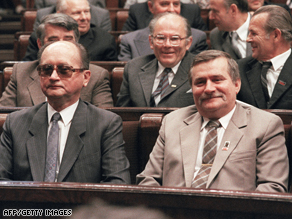
(CNN) -- One was the archetypal military strongman, intent on maintaining the social order and saving his country from "catastrophe." The other was a charismatic shipyard electrician and trade union leader who was just as determined to lead his countrymen to freedom.

Wojciech Jaruzelski and Lech Walesa attend the first multi-party session of the Polish parliament in 1989.

Wojciech Jaruzelski and Lech Walesa attend the first multi-party session of the Polish parliament in 1989.

Yet nowadays Wojciech Jaruzelski, the last leader of communist Poland, and Lech Walesa both claim, in their different ways, to have played their part in setting Poland on the path to democracy.

The rise of Solidarity, the union and social movement which Walesa founded among the dockers of Gdansk in 1980, was crucial to the ultimate collapse of communism in Poland and across the Soviet bloc.

Feted in the West, Walesa was awarded the Nobel Peace Prize in 1983 after spending nearly a year locked up as Jaruzelski clamped down on dissent, becoming a symbol of a rising tide of resentment behind the Iron Curtain.

By 1989, Solidarity had become an unstoppable social movement, sweeping to victory as the communist authorities relinquished their grip on power by allowing free elections. Walesa describes the union as a screw turning in the opposite direction to the communist regime, ultimately "destroying the engine."

"The system was 10 times less efficient than the western system," Walesa told CNN, recalling his decade-long struggle. "It paid less, life was worse. Each country enslaved by the Soviets was different and in Poland we had TV and people could travel so we knew life could be better... and we'd never given up."

But Jaruzelski still believes that without his decision to impose martial law in 1981, Poland's revolt against Soviet domination would have been as ruthlessly and violently quashed by Moscow as had those in Hungary in 1956 and Czechoslovakia in 1968.

"For me personally it was a great tragedy, the consequences of which I've felt to this day," Jaruzelski told CNN. "Martial law was evil. But it was less evil than the real and inevitable threat we were facing. There was a threat of an explosion -- and an explosion in Poland would have meant an explosion throughout Europe."

As a key link in the Soviet Union's chain of Eastern European satellite states, Jaruzelski believes Moscow would never have allowed Poland to break away peacefully: "I feared a terrible catastrophe. If martial law had not happened, Poland might have been flooded by a sea of blood."

Walesa admits the threat of Soviet intervention in the early 1980s was real, but says Solidarity had already won the argument against communism by the time Jaruzelski imposed martial law.

"I knew we were not going to fight," he said. "Because in Poland there were over 200,000 Soviet troops, they had nuclear arms, and they shot better than us. We could conquer them only this way: You can arrest us, but when we come out we do the same, and we will never work for communism again."

Autumn of Change: The New Poland
CNN looks back on the momentous events of 1989 as Poland cast off communism and sent shockwaves through Eastern Europe
June 6 0800ET/1400CET; June 7 1400 ET/2000 CET

Even his arrest and imprisonment only deepened Walesa's belief that Jaruzelski's government could be toppled: "My friends advised me to run away but I made a different decision. When they came to arrest me, I said, 'You have lost, I have won. You have just put the last nails into the coffin of communism.'"

These days Jaruzelski is no defender of the system which he served, describing communism as "beautiful and noble, but utopian." Yet he believes Solidarity's demands in the early 1980s amounted to an "economic time bomb" and that Poland was not ready for democracy at the time.

"The system was bad, I admit it today," he said. "But at the time, I wasn't aware of that. Everything has to ripen -- corn, fruit, man and societies. Western countries took centuries to arrive at democracy. Except for six or seven years after World War I Poland had never been democratic so it was a difficult process."

The Polish authorities also realized the urgency of economic and political reform, Jaruzelski adds, and had already begun the process before the Round Table talks with Solidarity in 1989 that led to elections.

"It was a difficult and painful process for both sides," he said. "I can talk primarily of the government side, and what huge resistance I had to overcome among the people who were in power -- in the party, in the state, the army and the security apparatus."

Both men pay tribute to outside forces which made the leap to democracy possible. For Jaruzelski, Mikhail Gorbachev's emergence in the Kremlin marked a "breakthrough moment" in which the threat of Soviet military intervention in Poland was lifted, and a possible end to the Cold War loomed into sight.

Walesa and Jaruzelski also acknowledge the unique role of the Polish-born Pope John Paul II and the Catholic church in brokering peaceful talks between the two sides.

For Jaruzelski, though, the fall of communism was not the product of Solidarity alone or a single summer of upheaval but "a great river made up of numerous streams."

"Nobody should monopolize that victory," he said. "Because in this stream there was Gorbachev; there was Reagan and then Bush, who caused the weakening of the Soviet Union by the arms race; there was Solidarity; there was the pope, and there were also -- which I will say without humbleness -- the reformists within the authorities at the time."

Both Jaruzelski and Walesa paint themselves as reluctant leaders. Jaruzelski describes his decision to become Polish prime minister as "one of the greatest mistakes of my life," while Walesa, who was elected Polish president in 1990, says it was never his wish to lead his country -- "but who else could have done it?"

Jaruzelski remains a divisive figure in modern Poland, derided by many as a living symbol of an oppressive past and occasionally summoned to court rooms to answer charges relating to his career as a leading servant of the communist regime.

"My generation, which remembers those times and can evaluate them in a balanced way, is passing away," he said. "And the new, younger generation, through school, books and TV, are being indoctrinated to be critical of martial law. Still, a large part of the society -- the majority, I think -- considers martial law to have been inevitable and justified."

advertisement

Yet even Jaruzelski says Poles can be "proud" of their role in the downfall of communist regimes across Europe: "The Polish elections preceded the revolutions in Hungary and in Czechoslovakia and the fall of the Berlin Wall. That impulse, that example that came from us, was of great significance and I think it is our great historical tribute."

Walesa, unsurprisingly, offers a more direct assessment: "Poland knocked out the teeth of the Soviet bear. Once we had done that, knocking down the Berlin Wall, the Velvet Revolution, all was made possible -- but only once the bear had no teeth."

wtorek, 14 października 2008

Poland's politicians row over foreign policy

Poland's foreign minister has begged the Polish president, 'on bended knee', to stay away from an EU summit as part of an escalating row between the country's government and president that threatens to derail Poland's foreign policy.

Dispensing with diplomatic niceties, Radek Sikorski, said it was imperative that President Lech Kaczynski stayed at home during the meeting of EU leaders in Brussels later this week.

"Mr President, I'm on bended knee," he said in a radio interview. "I'm begging you to forget it. "Don't go. Don't damage Poland's position." Despite the attack the president's office has said there will be only one Polish delegation in Brussels, and that it will be lead by Mr Kaczynski.

The heated dispute, which comes as the latest clash between president and government over foreign affairs, threatens to damage Polish attempts to portray itself as coherent and credible voice in the EU, especially with regards to forming policy towards Russia.

Pushing his constitutional mandate to the limit, Mr Kaczynski, who as head of state represents Poland abroad, has frequently riled Warsaw's government with his belief that Poland, and consequently Europe, should take a hard line towards Moscow.

Late last week the president labelled Mr Sikorski as soft on Moscow, and suggested that Poland's policy towards its eastern neighbour was dictated by Russian agents. In addition to this the president has also attacked the government over its stance on Georgia. In response the government has insisted that it runs foreign policy, and has criticised the president's involvement arguing that it undermines its goals and objectives

środa, 8 października 2008

CNN nie chce Krakowa nawet za darmo

Rafał Romanowski
2008-10-07, ostatnia aktualizacja 13 minut temu

Zobacz powiększenie
Nagłówek artykułu o Polsce na stronie internetowej CNN
Fot. cnn.com

Nawet za darmo nie pokażą Krakowa w CNN International. W ostatniej chwili amerykańska telewizja zrezygnowała z puszczania podczas "Polskiego tygodnia" nawet krótkich migawek z kościoła Mariackiego. Miejsce naszego miasta zajęły Sopot i Hel, a na dokładkę... Poznań

Informacje z Krakowa. Polecamy: Pokój za darmo wynajmę. Czyli za seks


- Materiału z Krakowa nie będzie. Po prostu wypadł z emisji. Na to miejsce ekipy CNN International dokręciły w ostatniej chwili sporo migawek z Wielkopolski - tak tłumaczy decyzję marketingowców nadającej dla 140-milionowej widowni na całym świecie telewizji Ola Głuchowska z agencji First PR reprezentującej Amerykanów w Polsce.

O sprawie pisaliśmy w "Gazecie" przed 10 dniami. Zbulwersowało nas, że Kraków jako jedyne z dużych polskich miast, którym zaproponowano ekskluzywną kampanię na antenie CNN International, nie zdecydował się na jej wykupienie i wyprodukowanie okolicznościowej reklamówki za okazyjną kwotę około 900 tys. zł. A gra była warta świeczki - taka sama kampania reklamowa w nadającej dla kilkaset razy mniejszej (i tylko polskiej) widowni telewizji kablowej TVN24 kosztuje... więcej, a i okazja do promowania się w CNN jest doskonała, bowiem stacja właśnie teraz, w drugim tygodniu października, nadaje program bezpośrednio z Warszawy w ramach cyklu "Eye on Poland" (liczne wywiady, reportaże, rozmowy, analizy - wszystko na temat Polski w kontekście tarczy antyrakietowej, sojuszu z USA, ruchu turystycznego, sytuacji politycznej, silnego złotego, lepszych wskaźników polskiej gospodarki od amerykańskiej).

Na mocne reklamowanie się w CNN postawiły władze Warszawy, Łodzi i Gdańska. Kosztem niecałego miliona złotych obecne są teraz na antenie CNN International z kręconymi tam reportażami, profesjonalnymi klipami i reklamowymi banerami w internecie (aż 530 tys. wyświetleń na odwiedzanym przez miliony internautów z całego świata informacyjnym portalu Cnn.com). - Taka promocja to strzał w dziesiątkę. Za stosunkowo małe pieniądze mamy zagwarantowaną oglądalność Gdańska na całym globie. I to w newralgicznym okresie wyborów Obama - McCain - cieszy się Grażyna Adamska z wydziału promocji gdańskiego magistratu. Podkreśla, że zgodnie z umową wiele z elementów kampanii zostanie na antenie stacji nawet do Bożego Narodzenia.


Kraków kampanii w CNN International nie ma, bo... zabrakło mu na nią pieniędzy w budżecie, a ponadto wynajęta krakowska agencja Epoka przekonała biuro promocji miasta, że wspomniany wabik dla widzów stacji w postaci wyborów w USA spowoduje, że reklamy Krakowa rzekomo "utoną" wśród innych informacji. - Pogratulować Krakowowi takich fachowców, którzy nie rozróżniają najprostszej rzeczy, czyli CNN International, gdzie tematy z USA są podawane równorzędnie z innymi, od CNN amerykańskiego, gdzie to Ameryka gra główną rolę - ironizuje Katarzyna Sławińska, przez kilka lat korespondentka TVN w Stanach Zjednoczonych.

Z ponadtygodniowym opóźnieniem władze Krakowa reagują na artykuł "Gazety" i w przesłanym nam liście tłumaczą, co spowodowało odwołanie kampanii teraz i ewentualne przesunięcie jej na... zimę 2009 roku. "Biorąc pod uwagę realnie małe możliwości zbudowania zasięgu i estymując ograniczony stopień skutecznego dotarcia z reklamą do uwagi przedstawicieli interesującej nas grupy potencjalnych odwiedzających, nasza rekomendacja była jednoznaczna - przesunąć emisję na okres, w którym widzowie będą bardziej podatni na komunikaty spoza merytoryki" - pisze Filip Szatanik z biura prasowego urzędu miasta. W innym fragmencie listu urzędnicy zawile przekonują, że jakoby już na początku sierpnia wiedzieli, co w październiku będzie przykuwać najmocniej uwagę widzów CNN International ("poważny kryzys ekonomiczny dotykający jeden z najważniejszych rynków na świecie"). Przypomnijmy: światowe media o kryzysie w USA zaczęły mocno informować dopiero w połowie września...

Co gorsze, po kompromitacji z niemożnością wysupłania niecałego miliona złotych dla CNN (przy prawie trzech milionach wydanych na obchody victorii wiedeńskiej króla Sobieskiego) oraz propozycjach oprowadzania ekip CNN po Warszawie przez... dziennikarzy z Krakowa z portalu Cracow-life.com, nasze miasto będzie musiało przełknąć jeszcze kilka gorzkich pigułek - wspomniany na wstępie nieoczekiwany darmowy splendor dla Helu, Sopotu i Poznania. Jak się dowiadujemy, miejsce obiecanych Krakowowi tak czy owak darmowych migawek z Rynku Głównego czy Kazimierza zajmą teraz m.in. materiały nakręcone w... siedzibie producenta autobusów Solaris z podpoznańskiego Bolechowa oraz wielkopolskiej bazy lotniczej w Krzesinach, gdzie stacjonują myśliwce F-16.

Sorry, CNN, Krakowa nie stać na kampanię. Przeczytaj więcej informacji z Krakowa


Źródło: Gazeta Wyborcza Kraków

wtorek, 7 października 2008

Telewizja CNN kpi z Tuska i podziwia Dodę

CNN zaczyna reklamować Polskę za granicą

Ekipa amerykańskiej stacji CNN przez tydzień będzie nadawać na żywo z kilku miast Polski i opowiadać o naszej polityce, historii, kulturze i gospodarce - pisze DZIENNIK. "Przyjechałem tu, żeby sprawdzić wiarygodność Donalda Tuska, który obiecał cięcia wszystkiego, co niepotrzebne. Jakoś nie widzę tych cięć maczugą" - żartuje Robin Oakley z CNN, który ma promować nasz kraj. A wśród największych Polaków wymienia Lecha Wałęsę i... Dodę.

CNN International, pierwsza i największa na świecie stacja nadająca program informacyjny całą dobę, rozpoczęła wczoraj emisję cyklu "Eye on Poland". To wyjątkowe wydarzenie, bo amerykańska telewizja jest niesłychanie popularna i prestiżowa. Program dociera do 1,5 mld ludzi w 212 państwach. Gratka jest tym większa, że CNN jest bardzo wybredna, jeśli chodzi o dobór tematów: muszą one być wystarczająco ekscytujące, by zainteresować widzów na świecie. Ale jeśli już jakieś państwo znajdzie się w tej telewizji, ma najlepszą promocję, jaką tylko można sobie wyobrazić.

Cykl "Eye on..." realizowany jest co kwartał, do tej pory poświęcono go m.in. Chinom, Francji, Brazylii czy Rosji. Decyzja, że teraz czas na Polskę, zapadła na początku roku. Wybór poprzedzony został bardzo starannym rekonesansem. "Wybieramy kraje, w których zachodzą najbardziej dynamiczne zmiany. Polska jest takim krajem" - mówi Mike McCarthy, wiceprezydent CNN International. Komentator polityczny CNN Robin Oakley, który nasz kraj nazywa "rzecznikiem i przewodnikiem dla tych, którzy chcą się uwolnić spod dominacji Moskwy", dodaje: "Męczyłem Mike’a od miesięcy, żebyśmy tu przyjechali".

Programem CNN zainteresował się prezydent Lech Kaczyński, który uznał pomysł za znakomity. Obawiał się jednak sposobu prezentacji. "W żadnym wypadku nie powinno się promować Polski za pomocą strojów ludowych. Polska powinna być przedstawiona jako kraj nowoczesny i już nie biedny" - mówił prezydent. Po pierwszym dniu widać, że obawy Lecha Kaczyńskiego były niepotrzebne.

Wczoraj widzowie mogli zobaczyć sukces polskiej firmy Solaris produkującej autobusy dla całej Europy i dowiedzieć się, że Polacy kochają uliczne, nielegalne wyścigi samochodowe. Widzieli też ministra sportu Mirosława Drzewieckiego, który oprowadzał reporterów po stadionie budowanym na Euro 2012. Po chwili widzowie już z relacji na żywo dowiedzieli się, że Polska może stracić Euro 2012 przez konflikt rządu z władzami PZPN.

Reporterzy zrobili wywiad z byłym prezydentem Lechem Wałęsą, ale też z piosenkarką Natalią Kukulską i tenisistką Agnieszką Radwańską. CNN przygotował również ranking najbardziej znaczących i wpływowych Polaków. Obok Kopernika, Chopina, Jana Pawła II, Wałęsy, Wajdy i Polańskiego znaleźli się w nim Robert Kubica, a także Doda i Joanna Krupa, polska modelka uznana za jedną z najbardziej seksownych kobiet świata.

Dziś ekipa CNN będzie nadawać na żywo z warszawskiej giełdy, w kolejnych dniach również z Pałacu Prezydenckiego. Gwiazdy tej stacji Fionnuala Sweeney i Robin Oakley doskonale orientują się w polskim życiu politycznym. "Przyjechałem tu, żeby sprawdzić wiarygodność Donalda Tuska, który obiecał cięcia wszystkiego, co niepotrzebne. Jakoś nie widzę tych cięć maczugą" - ironizuje Oakley. Z podobną swobodą opowiada o wicepremierze Waldemarze Pawlaku i ministrze spraw zagranicznych Radosławie Sikorskim, o którym mówi, wspominając niedawne negocjacje w sprawie tarczy antyrakietowej, że w pokera by z nim nie zagrał.

"Eye on Poland" zobaczą widzowie CNN International - międzynarodowej odnogi CNN. Jej siedzibą jest Londyn. I to głównie ekipa ze stolicy Wielkiej Brytanii przyjechała na tydzień do Polski. Fionnuala Sweeney do piątku będzie prowadzić poranny program z Warszawy. Jej wejścia można oglądać o 8, 9, 10 i 12.


CNN rzuca okiem na Polskę

mig
2008-10-06, ostatnia aktualizacja 2008-10-06 19:07
Zobacz powiększenie
Dziennikarka CNN w Warszawie na rynku Starego Miasta
Fot. Albert Zawada / AG Fot.

Polacy piją wódkę do śniadania, obiadu i kolacji, a po ulicach polskich miast biegają niedźwiedzie polarne? Telewizja CNN postanowiła zadać kłam obiegowym opiniom na temat Polski i wydobyć na światło dzienne to, co w naszym kraju jest szczególnie warte uwagi.

Zobacz powiekszenie
Fot. edition.cnn.com
''Polska jest największym z ''niewielkich''krajów Europy'' - rozpoczyna się artykuł w CNN o Krakowie
Zobacz powiekszenie
Fot. edition.cnn.com
Artykuł o sławnych Polakach
Zobacz powiekszenie
Fot. edition.cnn.com
Na stronie internetowej CNN pojawił się cykl artykułów poświęconych Polsce. Na zdjęciu artykuł o życiu po obaleniu komunizmu
ZOBACZ TAKŻE

Kopernik obok Dody - najsłynniejsi Polacy wg. CNN Czytaj


W cyklicznym programie "The Eye on Poland" (Rzut oka na Polskę), reporterzy CNN będą przedstawiać różne aspekty życia w naszym kraju - od biznesu, przez politykę, po kulturę popularną, starając się udowodnić, że Polska to kraj pełen barw i kontrastów.


Polska to kraj o dumnej przeszłości i świetlanej przyszłości. To jedno z najszybciej rozwijających się państw Europy, którego znaczenie na arenie międzynarodowej stale rośnie - przekonuje CNN. Dzięki wykwalifikowanej sile roboczej Polska rozszerza wpływy daleko poza swoje granice, a dzięki sprawnie działającej gospodarce przyciąga rzesze zagranicznych inwestorów. Nie ma wątpliwości - twierdzą reporterzy CNN - nastała nowa era dla Polski.

Euro 2012 - wciąż jeszcze polskie

"Patrząc na Stadion X-lecia w Warszawie, trudno wyobrazić sobie, że ma on być głównym obiektem sportowym piłkarskich mistrzostw Euro 2012. Na razie to tylko olbrzymia dziura w ziemi otoczona górą piachu" - komentuje reporter CNN Phil Black. Czy Polska zdąży z organizacją Euro i nie zaprzepaści swojej szansy? Minister sportu Mirosław Drzewiecki przekonuje amerykańską stację, że Polska, mimo groźby odebrania jej organizacji imprezy, podoła zadaniu, a przeżytek ery komunizmu, jakim jest Stadion X-lecia stanie się wkrótce obiektem klasy światowej.

"Ale Stadion Narodowy to nie jedyna inwestycja, która musi zostać ukończona w ciągu zaledwie 4 lat" - zauważa reporter. Podobne obiekty powstają (lub powstały) też w innych polskich miastach, takich jak Poznań, Gdańsk, Wrocław, Łódź i Kraków.

"Przez 40 lat komunizmu i 19 lat demokracji w Polsce zaniedbano nie tylko sport. Zatrważający jest również stan polskich dróg" - opowiada Black, a kamera robi najazd na podziurawione ulice w centrum Warszawy. Zaraz potem słychać narzekania warszawiaków, o tym, że jazda samochodem w Polsce to prawdziwy koszmar, i że brakuje autostrad. "Czasu jest niedużo, a trzeba będzie zbudować 3000 km dróg, lotniska, stacje kolejowe, hotele" - wylicza reporter. To inwestycja warta w sumie 140 mld dolarów. Ale pieniądze, zdaniem Blacka, to nie główny problem. Polska uzyska bowiem środki z Unii. Znacznie gorzej jest z siłą roboczą. Reporter przypomina o tym, że większość wykwalifikowanych robotników wyjechało z Polski, głównie do Wielkiej Brytanii, w poszukiwaniu lepiej płatnej pracy.

Jak przekonuje amerykański reporter, Polacy sami nie dowierzają w sukces przedsięwzięcia i krytykują władze za opieszałość przy organizacji Euro 2012. "To się skończy wielką katastrofą i wstydem. Odbiorą nam Euro i tyle" - komentują Polacy. "Byłoby szkoda - ocenia reporter - bo dla Polski Euro to szansa, nie tylko żeby wypromować rodzimy futbol, ale żeby dzięki inwestycjom dogonić Europę Zachodnią i podnieść poziom życia".

Polski autobus na obce drogi

Polska ma coraz więcej do zaoferowania - przekonuje reporterka CNN Diana Magney, podczas wizyty w polskiej fabryce autobusów Solaris pod Poznaniem. "Te wyjątkowe hybrydowe pojazdy kupuje od Polaków cała Europa" - zachwala Solarisy Magney, a kamera pokazuje różnokolorowe, eleganckie autobusy: czerwono-żółty dla Warszawy, zielono-żółty dla Poznania, szaro-żółty dla Berlina. Chciało by się rzec: "do wyboru, do koloru". "Zagraniczni konkurenci mogą się tylko od nas uczyć" - mówi CNN jeden z pracowników firmy.

Reporterka opowiada też historię rodziny Olszewskich, właścicieli Solarisa, na tle przemian zachodzących w Polsce. Pojawia się wątek "Solidarności", stanu wojennego, emigracji, wreszcie gospodarki wolnorynkowej, która pozwoliła na zbudowanie firmy obecnej na arenie międzynarodowej.

"Do tej pory Polska kojarzyła się głównie z tanimi surowcami, tanią siłą roboczą i tanimi produktami, autobus Solaris jest dowodem na to, że dziś "Made in Poland" oznacza nie tylko niską cenę, ale również wysoką jakość" - podsumowuje reporterka.

Polaków pasja do samochodów


"W komunistycznej Polsce samochód był towarem luksusowym, na który długo się czekało i długo oszczędzało" - opowiada reporter Phil Black. "Ale czasy się zmieniły - rośnie nie tylko grono szczęśliwych posiadaczy samochodów, ale i wielbicieli wyścigów samochodowych" - przekonuje amerykański reporter.

Zdaniem CNN, jedną z atrakcji w Polsce są nielegalne wyścigi samochodowe. Nocą Polacy mkną ulicami miast w podrasowanych autach, testując swoje umiejętności i możliwości swoich pojazdów. W Łodzi wyścigi stały się tak powszechne, że policja, zamiast z nimi walczyć, włączyła się w ich organizację. "Dajemy im się wyszaleć podczas oficjalnych zawodów, żeby nie organizowali wyścigów na dziko" - opowiada CNN Krzysztof Szymański z łódzkiej drogówki.

"Rodzice rajdowców-amatorów mogli tylko pomarzyć o tym, żeby mieć choć namiastkę samochodu, jakim ścigają się dziś ich dzieci. To właśnie takie auta odzwierciedlają nową ekonomiczną rzeczywistość Polski" - podsumowuje Black.

New York Times: Wyścigi - nowe hobby Polaków


Skłodowska-Curie była Polką

Oprócz reportaży dotyczących życia w Polsce, CNN prezentuje też sylwetki znanych Polaków. Widzowie mogą się z nich m.in. dowiedzieć, że Maria Skłodowska-Curie nie była Francuzką, papież Jan Paweł II naprawdę nazywał się Karol Wojtyła, a Kopernik był pierwszym, który "ruszył Ziemię i wstrzymał niebo".

komentarze na Forum

poniedziałek, 6 października 2008

Dziennikarz CNN: Polska to najciekawszy kraj Europy

Robin Oakley, fot. CNN

- Jeśli niestrudzony w produkowaniu medialnych czołówek Nicholas Sarkozy, francuski prezydent, jest obecnie najbardziej interesującym politykiem w Europie, to szybko ewoluująca Polska błyskawicznie staje się najbardziej interesującym krajem Europy, biorąc udział w niemal każdej ważniejszej batalii politycznej - pisze na swoim blogu Robin Oakley, jeden z najważniejszych politycznych dziennikarzy stacji CNN. Dziś w tej stacji rusza seria filmów dokumentalnych o naszym kraju "Oko na Polskę".
- Polska była bardzo istotnym punktem programu powiększania Unii Europejskiej, jej wejście poprawiło wewnętrzne nastroje Unii w niepewnych czasach. I Polska łatwo dowiodła, że może zrobić więcej niż tylko zademonstrować swoje znaczenie w dyplomacji - pisze Oakley. - Współuczestnicząc w wysiłkach zbliżenia Ukrainy i Gruzji do NATO i Unii Europejskiej Polska stała się nieoficjalnym cheerleaderem dla tych, którzy chwialiby uwolnić się spod moskiewskiej dominacji - dodaje.

Weź udział w filmowym konkursie CNN i Onet.pl

- Nie było więc niespodzianką, że badania ARCO Insight wykazały w ubiegłym miesiącu, że decydenci w Brukseli uznali Polskę za kraj najbardziej skuteczny we wpływie na politykę Unii spośród dwunastu jej najnowszych członków - ocenia dziennikarz CNN. Bardzo chwali postawę polskiego rządu podczas negocjacji ws. tarczy antyrakietowej. - Nie chcielibyście zagrać w pokera z Radkiem Sikorskim - komentuje. Zdaniem Oakleya, "Polska nauczyła się dużo lepiej układać się ze swoim potężnym sąsiadem – Niemcami, utworzyła także użyteczny, praktyczny alians ze Szwecją dla propagowania interesów regionu bałtyckiego oraz zaprzestała blokowania członkostwa Rosji w różnych dyplomatycznych klubach".

Jako główne problemy naszego kraju, dziennikarz CNN wymienia opóźnienia w budowie infrastruktury i "biurokrację lat komunizmu". - Ale to, co Polska ma, to energia ludzi, populację o stosunkowo wysokim poziomie edukacji technicznej i determinacji do walki o lepsze i niezależne życie, po obcych wojskach okupujących kraj przez osiemdziesiąt procent ostatnich 200 lat. To jest kraj w biegu - podsumowuje optymistycznie Oakley.

Robin Oakley jest politycznym dziennikarzem CNN. Pracujący na co dzień w Londynie Oakley, jest jednym z głównych komentatorów politycznych na świecie.

Z ponad 40-letnim doświadczeniem w dziennikarstwie politycznym, Oakley przybliża widzom CNN zagadnienia związane z wydarzeniami politycznymi dotyczącymi państw europejskich, grupy G8, Unii Europejskiej i NATO Specjalizuje się również w komentowaniu referendów i wyborów oraz analizowaniu długofalowych następstw decyzji politycznych.

sobota, 16 sierpnia 2008

Bolt breaks 100-meter record, wins Olympic gold

BEIJING – Pure speed.

It emanated from those loping, waist-high strides 6-foot-5 Usain Bolt churned with his golden spikes — untied lace and all — to win the 100-meter Olympic gold medal and break his own world record Saturday night.

It was there for all to see, too, in the "Is that really possible?!" gap of several feet between the Jamaican and the rest of the field at the finish. And, of course, in those bright, yellow numbers on the red-and-black trackside clock blaring the official time: 9.69 seconds.

Pure joy.

It radiated from Usain Bolt's wide eyes as he playfully nudged an opponent during the prerace stroll through the stadium hallways, and, moments later, when he clowned with one of the volunteers at the start line before handing her his black backpack.

It was there for all to see, too, in his "How good am I?!" mugging for the cameras with about 20 meters to go, already certain victory was steps away — outstretched arms with palms up, slap to his chest while taking the last of his oh-so-long 41 strides, leaning back to enjoy the moment instead of leaning forward in effort. And in the arms-swaying dance moves he showed off as reggae music flowed from the loudspeakers to help him celebrate.

"I was having fun," Bolt said. "That's just me — I like to have fun."

Oh, did he have a blast on this night, making obvious he is head-and-shoulders above the competition — and not merely because he really is head-and-shoulders above the competition, towering above foes in an event where no world record-holder over the last two decades has been this tall and where some didn't even reach 6 feet.

Those lanky legs allow Bolt to cover more ground, but his turnover for each stride also takes longer. He might just be turning the dash into a big man's event, though.

Bolt's sudden emergence truly began May 5 in Jamaica, when he ran 9.76 seconds, just shy of countryman Asafa Powell's then-record 9.74. This was someone to watch. Then, on May 31 in New York City, Bolt broke Powell's mark by finishing in 9.72.

Now that is gone, too, and Bolt's 0.20-second margin of victory matched the largest in an Olympic 100 final over the last 40 years.

"He's just a phenomenal athlete," said Trinidad and Tobago's Richard Thompson, the NCAA champion from LSU who won the silver by finishing in 9.89, "and I don't think anyone would have beaten him with a run like that today."

Certainly not. Bolt turned in as transcendent a show as Olympic track and field has seen in years, perhaps dating to Michael Johnson's world-record 19.32 seconds in the 200 meters at the 1996 Atlanta Games.

That mark could be next for Bolt, who considers the 200 his specialty. The heats for that event begin Monday, and the final is Wednesday, a day before his 22nd birthday.

"It definitely brings track back," said Walter Dix of the United States, the bronze medalist in 9.91.

Back to the front pages. Back from being ignored, spurned even, after a series of drug cases that stripped medals and credibility.

It's all particularly remarkable when you consider that Bolt — from the same yam-farming Trelawny parish in his Caribbean nation that was home to Ben Johnson — only began competing in the dash 13 months ago.

"I told you all I was going to be No. 1," Bolt said, "and I did just that."

Even though his left shoelace was dangling, the knot undone. Even though he skidded out of the starting blocks with the seventh-slowest reaction time in the eight-man final. Even though as recently as this month, Bolt left some doubt as to whether he would even contest the 100 in Beijing, because he didn't want to disrupt his preparation for the 200.

The talk for weeks has been about how Bolt might hold up in the four-round format at the Olympics, and how he'd do squaring off against Powell and reigning world champion Tyson Gay of the United States.

That didn't pan out. Gay, who acknowledged he paid for being sidelined the past 1 1/2 months after injuring his left hamstring at the U.S. Olympic trials, didn't even make the final, finishing fifth in his semi. Powell, meanwhile, was fifth in the final for a second consecutive Olympics, adding to his reputation for flopping on the big stage.

"Usain was spectacular," Powell said. "He was definitely untouchable tonight. He could have gone a lot faster if he had run straight through the line."

How low might Bolt be able to push that time?

9.65?

9.59?

"Anything is possible. The human body is changing, so you never know," Bolt said. "I aim just to win, but when I saw the replay, I was amazed."

So was everyone else: the competition, if you can really use that term to describe the other runners; the 91,000 or so fans whose photo flashes filled the still night air; the millions watching on TV.

Years from now, people will look at the images from the finish of the men's 100 meters at the 2008 Olympics and ask: Was Usain Bolt given a head start?

Was it possible for one man to end up that far ahead of seven other men, seven other elite sprinters, the best the world has to offer?

It was, after all, the first Olympic 100 in which six men finished in under 10 seconds. One of them, sixth-place finisher Michael Frater of Jamaica, described Bolt's new record this way: "No one will get near it."

Well, perhaps no one other than Bolt.

There were other events on this clear night, other medals awarded. Nataliia Dobrynska of Ukraine won the heptathlon, with Hyleas Fountain earning a bronze for the first U.S. medal in that event since 1992. Valerie Vili won the women's shot put, giving New Zealand its first Olympic gold medal in track and field since 1976. The favorites advanced to Sunday's semifinals in the women's 100.

Ho-hum.

Nothing that could help restore some of track and field's luster the way a dazzling sprinter can.

His coach wanted Bolt to add the 400 to his repertoire instead of the 100, figuring height would help at the longer distance. But Bolt insisted on taking on the shorter event, in part, he admits, because it's, well, shorter. Less taxing. Less time spent running, sweating, working out.

Bolt enjoys cars — speed, clearly, is what drives the guy — and, like many twentysomethings, he likes to go out with pals and dance. He's been frank about realizing he needed to go to the gym more and party less to fulfill the potential that's been evident since he became the youngest-ever male world junior champion in the 200 at age 15.

In some ways, he still is a kid at heart. His Saturday morning began with some television-watching, followed by some chicken-nugget-eating. Then he turned the TV back on, before deciding to take a three-hour nap.

In the evening, a very special 9.69 seconds — read those numbers again, slowly — changed his life. After he kissed those shoes of his, and posed for photo after photo, Bolt finally walked barefoot off the rust-colored track that will always be meaningful to him and his sport. He was handed a telephone: Jamaican Prime Minister Bruce Golding was on the line.

Later, after Bolt left the stadium's drug-testing area, he was mobbed by Olympics volunteers who wanted autographs on scraps of paper or their sky-blue shirts. They wanted photos of him.

And then along came a car and driver, and Bolt slid into the front seat.

The "World's Fastest Man" is enjoying the ride.

Phelps’ seventh gold most incredible yet


Yahoo! Sports

BEIJING – The computer called it one-hundredth of a second, but technology is a fantastic liar. Imagine the time it would take to travel between a pair of atoms on the tip of a needle – that was the difference that delivered Michael Phelps his seventh gold medal.

But clarity didn’t come before thousands of eyes snapped quickly upward to the giant screen, officially registering Phelps’ victory inside Beijing’s Water Cube. A collective stare was followed by a rolling whoosh of American joy and disbelief as his name popped up one-hundredth of a second faster than Serbia’s Milorad Cavic – 50.58 seconds to 50.59.

Good enough for an Olympic record, and fast enough to touch off an explosion in the bleachers looming overhead: “WHOOOOOOOAAAAAA!”

Phelps went into the final 50 meters of Saturday’s 100-meter butterfly in seventh place, then shovel-kicked his way to a victory that could hardly be measured in the length of an eyelash. Even he had to take off his goggles and eye the scoreboard to believe it, at which point he slapped his spindly fingers into the water and let out a roar of “Yeaaaaaaaaaaah!”

At that very moment, the Serbian swimming team was looking up at the same results from the edge of the pool deck, screaming another chorus of “NO!” The Serbians would later protest the results, to the point that FINA had to slow the end of the race down to one ten-thousandths of real time. The video and timing system showed that Phelps had indeed won, if only by a few cells at the tips of his fingers. Even the Serbs had to relent after FINA ushered them into the video room and showed them frame-by-frame results. But even now, the win looks indecipherable to the naked eye.

“I saw the finish on the big screen after the race and then I saw it slowed down frame by frame at the massage area,” Phelps said. “I was looking at the computer, and it’s almost too close to see. One one-hundredth is the smallest margin of victory in our sport. It’s pretty cool.”

Pretty cool and pretty stunning – a finish that provoked a range of the most raw human reactions possible. Two fans in cowboy hats leaned over a railing near the center of the pool and shrieked at each other over the chaotic finish, “He’s gonna lose! He lost! He lost!” Journalists leapt from their seats in disbelief, some scrambling to change the tops of their stories to match a headline of “PHELPS DEFEATED.” But the computer said otherwise, and video would back it up later.

Cavic clearly didn’t believe at first. Multiple replays in slow motion looked too close, something that apparently didn’t sit well immediately after the race. The silver medalist sped by reporters, looking disgusted and waving off interviews. He headed straight toward a coach from his Serbian team, who wrapped his hands around Cavic’s neck and looked him in the eyes.

“You won,” his coach said.

Cavic nodded and collapsed his 6-foot-5 frame into an embrace. The man who Friday looked at Phelps and said, “It would be good for the sport if he lost,” thought he had delivered the most unpopular booster shot in the history of swimming. And when he found out he hadn’t, he slowly graduated through every conceivable emotion – anger, disgust, acceptance and then, finally, understated happiness over having captured his country’s first ever medal in swimming.

“I’m sure people will be bringing this up for years, saying that, you know, ‘You won that race,’” Cavic said. “Well, this is just what the results showed. This is what the electronic board showed. I kind of have mixed emotions about it. This could be kind of a good thing. If I lost by a tenth of a second or two-tenths of a second, I could probably be a lot cooler about this. But with a hundredth of a second, I’ll have a whole lot more people saying, ‘You really won that race.’

“Is Michael Phelps the gold-medal winner? I think if we had to do this again, I’d win.”

It’s that kind of bravado that may have crept back to haunt Cavic. Just before the race, Phelps’ coach, Bob Bowman, looked at his star and repeated the words.

“It would be good for swimming if you lost,” Bowman said.

It was the perfect dig at the perfect time.

“I always welcome comments,” Phelps said later with a grin. “If anybody wants to say anything, I’ll always welcome it. I like it. It definitely motivates me even more.”

Phelps and Cavic actually had a brief moment before the race where each stood staring at each other, both waiting to step up on their blocks. Neither looked away for that one moment – like two fighters standing at center ring waiting to tap gloves.

“Both of us have metallic goggles, so I couldn’t see his eyes and he couldn’t see mine,” Cavic said.

Once they finally hit the water, Phelps didn’t come out as fast as many expected, particularly after the 50-meter turn. Phelps was at the rear end of the entire field at that point, a half-body length behind Cavic and teammate Ian Crocker – a pair of historically fast starters. But Phelps began chopping into that lead almost immediately, moving up to fourth place by the final 25 meters. That set up the ending that swimming aficionados predicted, with the final 10 meters a dead heat between Phelps and Cavic.

It wasn’t until the last stroke of both swimmers that the race was decided, when Cavic chose to glide in underwater for his last two meters, while Phelps forced in one last stroke coming out of the water and chopping downward onto the wall to finish. In that last moment, Phelps thought the decision to “chop the wall” had lost gold.

“I really thought that cost me the race, but it happened to be the direct opposite,” Phelps said. “If I would have glided, I would have ended up being way too long. I ended up making the right decision. Trying to just take sort of a short, fast stroke to try to get my hand on the wall first – it turned out to be in my favor.”

And it was that moment – that decision – which delivered Phelps his history, tying him with Spitz, both now having won seven gold medals in a single Olympic games. It also set the stage for Phelps carving out his own plateau with one event left. After Sunday’s 4x100 medley relay, in which the Americans have never lost and are overwhelming favorites for gold, Phelps should own the impossible dream of eight gold medals.

“It seems like every day I’m in sort of a dream world,” Phelps said. “Sometimes you sort of have to pinch yourself to see if it’s really real. I’m just happy I’m in the real world.”

poniedziałek, 12 maja 2008

Pole who saved ghetto Jews dies

Page last updated at 11:38 GMT, Monday, 12 May 2008 12:38 UK

Irena Sendler
The Polish parliament honoured Irena Sendlerowa last year for her heroism

The death of a Polish woman who almost certainly saved the lives of 2,500 Jewish children during World War II has been announced.

Irena Sendlerowa organised the rescue of the children from the Warsaw Ghetto during the Nazi occupation.

She died in a Warsaw hospital at the age of 98, her daughter said.

After Germany's invasion of Poland in 1939, she took great risks to help Polish Jews held by the Nazis - an act that was punishable by death.

In 1942 Irena Sendlerowa joined the Zegota resistance movement.

With the rest of her team of 20, she rescued the children between 1940 and 1943, when the Nazis burned the ghetto, condemning its residents to death.

Saved from execution

In October 1943 she was arrested and tortured by the Gestapo, but refused to give up the names of the children.

She was saved on the day of her scheduled execution after the Polish underground bribed her SS guards.

She said persuading parents to part with their loved ones was particularly traumatic.

The children were smuggled out in different ways - in ambulances, through the sewers, and once under her skirt.

The BBC's Adam Easton in Warsaw says Irena Sendlerowa hated the term "hero", and said her conscience was troubled because she had done so little.

Last year the Polish parliament unanimously passed a resolution honouring her for organising the "rescue of the most defenceless victims of the Nazi ideology: the Jewish children".

In recognition of her efforts she has also been awarded the title Righteous Among the Nations, by Israel.